
Forbidden Island and Forbidden Desert both ask a team to collect four things and escape a dangerous board. Both give players special roles, and both let the group discuss what to do. If you are choosing which to buy—or wondering whether Desert adds enough to an Island you already own—the useful distinction is what you want to organize together.
Choose Island if arranging card handoffs and keeping vital places reachable sounds appealing. Choose Desert if you want to search for locations on a moving board while also looking after individual water supplies. A fifth player settles one part of the decision immediately: Desert takes five; Island stops at four.
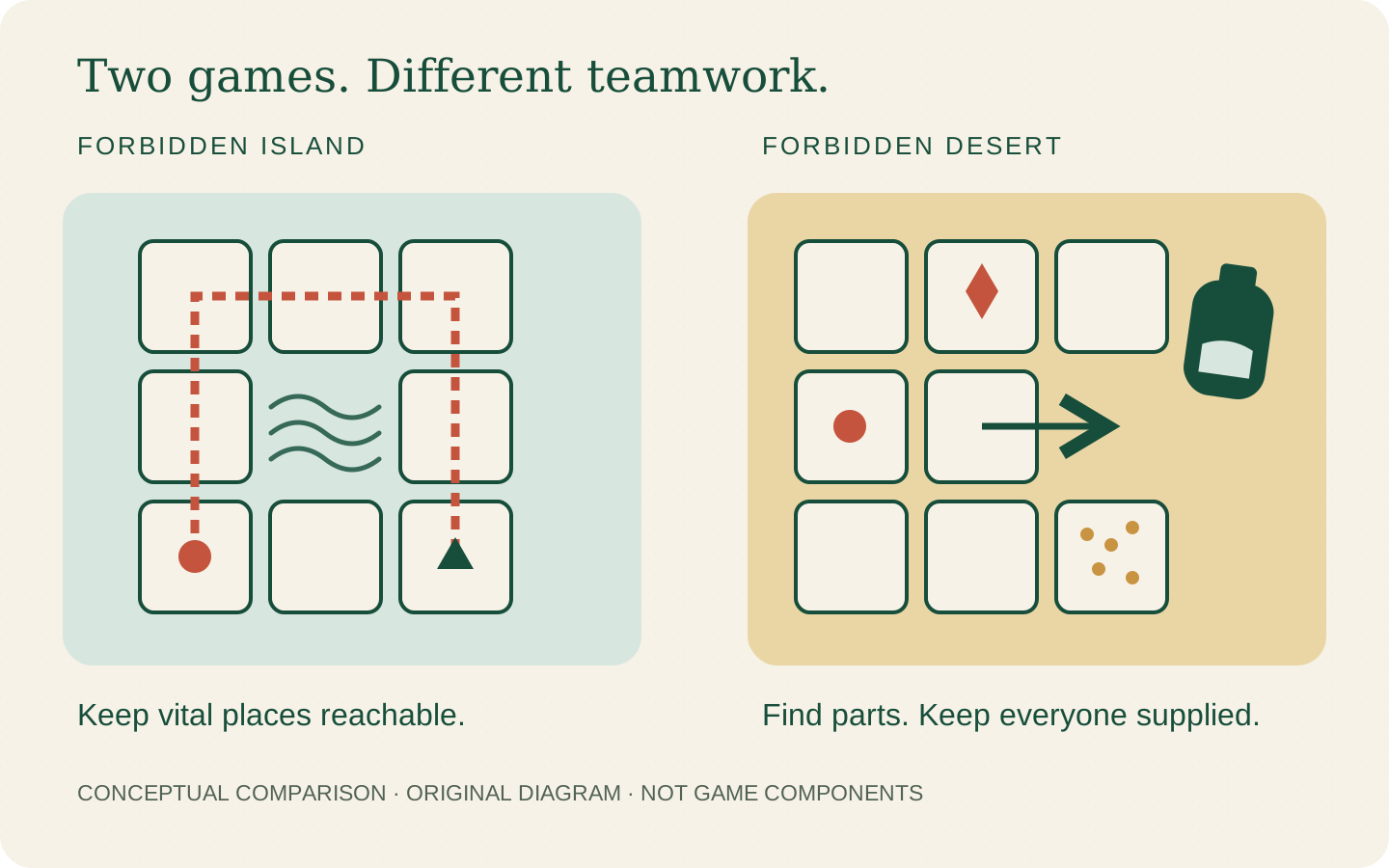
Island: the right cards still need the right place
In Forbidden Island, one player spends an action and four matching cards to claim a treasure at one of its two collection sites. Giving a card normally costs an action and requires both players to share a tile. The Messenger can give remotely; other roles change how players travel or repair the island.
Suppose you hold three matching treasure cards and a teammate holds the fourth. You need a meeting point, an action to give the card, and a route to a collection site. That turns a promising hand into a team travel plan. It also gives the rest of the group a reason to protect a route that is not on their own way to a treasure.
Flooding makes that coordination urgent. A flooded tile can be shored up, but if its flood card appears again before that happens, the tile is removed. Ordinary movement cannot cross the gap. Losing both sites for an unclaimed treasure ends the game, so keeping the right places available matters as well as collecting cards.
This is the appeal if you like a clearly visible shared priority: decide who should collect which cards, then work out how to get them there. The plan can change as the island shrinks, but you can point to the places you are trying to preserve.
Desert: locating a part does not finish the journey
Forbidden Desert replaces treasure-card sets with excavation and clues. Each part has a row clue and a column clue. Revealing the second places the part where they intersect. From then on it travels with that tile; you follow the part rather than repeatedly recalculating its location from the clues.
The storm shifts tiles, taking pawns, sand, and parts along with them. Sand can block ordinary movement until cleared; it does not permanently remove the tile as Island flooding can. Your route to a known part may therefore change, and a tile you have already explored may still need attention.
That creates two different kinds of progress. You can reveal information about where a part will appear, or make an already located part reachable. If the group enjoys choosing between searching and clearing a route—and revising that choice when the board moves—Desert gives it that problem.
Water gives Desert another reason to bring players together
Water belongs to individual adventurers. Sun cards drain unprotected players, and one adventurer dying of thirst loses the game for everyone. Sharing water is free on the same tile. Excavating a real well benefits the players already there, so a promising discovery may be worth waiting to uncover until others arrive.
Those rules make a detour or rendezvous matter even when it does not immediately recover a part. The Water Carrier changes some of those options, including replenishing water at excavated wells and sharing with adjacent players. Read the roles as part of the team’s plan.
Desert therefore asks you to track personal needs alongside the group’s exploration. Choose it if that extra coordination is what you want. If you prefer concentrating on shared card sets and protecting a shrinking route network, Island already offers that without individual canteens.
The choice for a new buyer or an Island owner
For a first purchase with two to four players, decide which conversation you would rather have: who can assemble and deliver a card set, or where to search next while keeping everyone supplied. The comparison is more useful than assuming that the sequel is automatically the better purchase.
If you own Island and want more pressure within its familiar rules, try a higher starting water level or a different mix of roles before buying another game. Look at Desert when you want its shifting geography, clue intersections, and water decisions. Those are changes to the planning, not just a new setting for the same tasks.
Neither game stops one person from offering everyone else a plan: both rulebooks encourage team advice. If that worries your group, agree how suggestions will work rather than expecting Desert’s extra systems to solve it.
Scroll across the comparison if needed.
| Publisher specification | Forbidden Island | Forbidden Desert |
|---|---|---|
| Players | 2–4 | 2–5 |
| Age label | 10+ | 10+ |
| Published playing time | 30 minutes | 45 minutes |
Allow for the escape, too
Collecting everything is not the finish in either game. Island requires everyone at Fools’ Landing and a Helicopter Lift card to leave. Desert requires the team and recovered parts at an unblocked Launch Pad. Include that final meeting in the kind of coordination you are choosing.
The times above are Gamewright’s estimates. Allow extra time to set up and explain either game.