
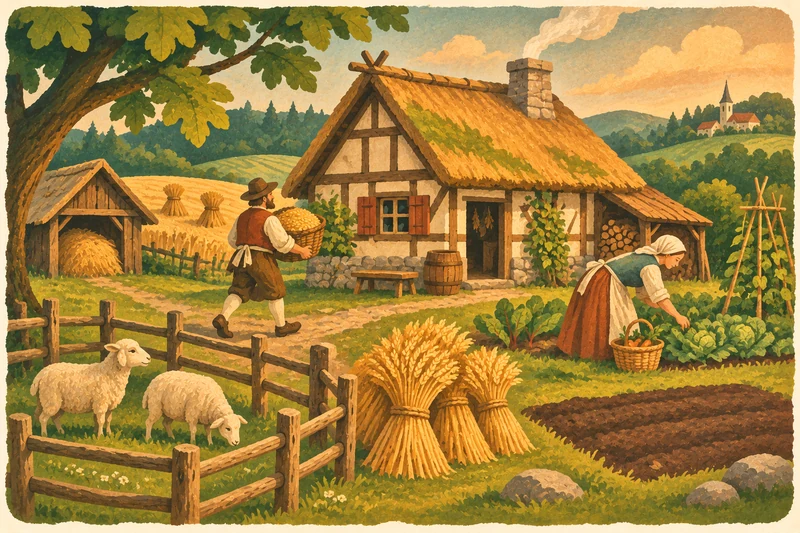
A bigger family can accomplish more, but it also needs more food. Agricola makes that tradeoff the centre of building your farm: the wood you spend on another room could have fenced a pasture, and the action you use to collect dinner could have planted a future harvest. Your farm takes shape through what you can afford to postpone.
How it plays
You begin with two family members and a small wooden house. Players take turns placing one family member on a shared action space to collect materials, plow a field, build rooms or do another job. Normally, an occupied space is unavailable for the rest of that round, so another player's choice can force you to rearrange your plans.
Turn those actions into a working farm: fence pastures for animals, sow crops for later harvests and build improvements such as fireplaces or ovens that help turn produce into food. Occupation cards represent useful skills, while improvement cards add equipment and other benefits. Your private cards offer opportunities, but playing them competes with the work needed on the farm itself.
After the harvest in round fourteen, score your family, developed farm, crops, animals and scoring cards. Missing types of produce or livestock and unused farm spaces cost points. In multiplayer, the highest total wins, so a reliable food supply is a foundation for developing a varied farm rather than the whole objective.
Decisions you’ll make
Growing your family gives you more actions in later rounds. The earlier growth action requires a spare room, so expansion first demands materials and building work, then leaves you with another person to feed. Its value depends on whether your food production can support the extra worker.
Wood left on its collection space accumulates into a larger haul, but waiting gives another player the chance to take it. Collecting a smaller pile now can secure a crucial building plan; waiting might make your action more efficient and leave you without the material when you need it.
Learning the game
Learn food production and the scoring categories before planning an elaborate farm. Taking grain, sowing it and baking bread are distinct steps; owning the ingredients does not automatically put dinner on the table.