

A partner points to one card in your hand and tells you it is blue. You leave it alone. Later, they explain that they wanted you to play it. Did you miss something you could have worked out, or something the two of you never agreed?
Try the same clue in three situations. Each changes what you can reasonably conclude, even though the spoken information stays the same.
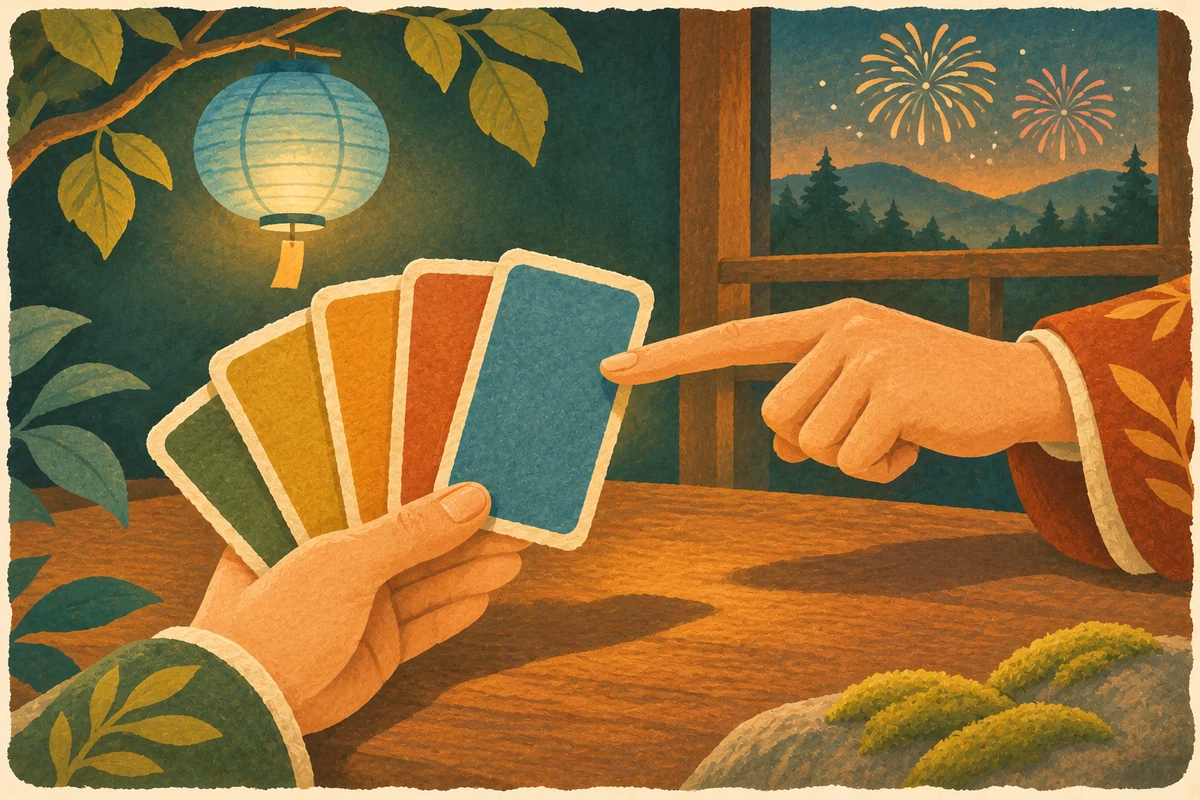
First, what playing the card would do
Hanabi is cooperative: everyone contributes to five shared fireworks, one per color. Each firework is a sequence built from 1 through 5, without gaps or duplicate numbers. If blue has reached 2, only a blue 3 can extend it. A blue 4 is too early; another blue 2 is already unnecessary.
The catch is that you hold your cards facing outward. Your partners see their fronts; you do not. On your turn you choose one action: give a clue, discard a card, or attempt to play one. A successful play extends a sequence. An unsuccessful play loses the card and records a failure; the third failure ends the game.
Giving a clue spends an available information token. You identify every card of one chosen color in one partner's hand, or every card of one chosen number. You cannot select just one of their two blue cards. Those are the foundations of the following exercise, using the five-color base game in the publisher's French rules.
Situation one: blue is all you know
Here is an invented three-player position. You hold five cards. Blue has reached 2. Your partner spends a token and points to exactly one card while giving a blue clue. No earlier clues identify that card. The other visible cards and discards leave both blue 3 and blue 4 possible.
What has the clue established?
The pointed card is blue, and your other four cards are not blue. That second fact follows because the clue must include every blue card you hold. But nothing here establishes the pointed card's number.
To check that, imagine two possible hands: blue 3, red 1, green 4, yellow 2, white 4; or the same hand with blue 4 replacing blue 3. You cannot see which hand you hold. Both fit the clue and the stated position. Playing the pointed card succeeds in the first and fails in the second.
Perhaps your partner chose blue because the card is playable. That is a plausible explanation of their choice. It becomes a dependable message only if you have grounds for expecting them to use the clue that way.
Situation two: the card already had a number
Reset to the same position, with one change to its history. An earlier number-3 clue pointed to that same card alone. You have kept track of it, and it has remained in your hand. Your partner now gives the identical blue clue.
Now what follows?
The earlier clue establishes 3; the new clue establishes blue. Together they identify blue 3. With the blue sequence still ending at 2, the card can extend it.
This conclusion needs no agreement that blue means play. Your partner could have chosen the clue for an entirely different reason and the two facts would still combine. You can explain your confidence by naming the information and the current sequence.
The earlier clue is compatible with the example hand: none of its other four cards is a 3. There is no hidden exception to the requirement to identify every matching card.
Situation three: the group has made a promise
Reset again. Remove the earlier number clue. Instead, suppose everyone agreed before this exercise: a color clue that identifies exactly one previously unclued card asks its holder to play that card on their next turn. Assume the giver applies this agreement correctly and blue remains at 2 until your turn.
You now have a reason to interpret the blue clue as a play request. Under that agreement, the giver is promising a playable blue card. Since only blue 3 fits, you infer blue 3.
The missing number has been supplied by an expectation about the giver's choice. If they misunderstood the agreement and pointed to blue 4, the color information would still be true. The promise would be wrong.
This simple agreement is invented for the exercise, not a complete strategy system. Actual convention systems supply more context. The H-Group introduction assumes readers already know Hanabi's rules; its Play Clues lesson explains interpreting clues as requests to play within that group's approach. Learning the rules and learning partners' expectations are separate tasks.
One last change
Return to situation two, where two clues identify your card as blue 3. Before your turn, another player successfully plays the other blue 3. Should yours still go down?
No. Its identity remains certain, but its usefulness has changed. Blue now needs 4. Your blue 3 would duplicate a number already played and cause a failure.
Before your next game, agree whether a newly identified card requests play, when a clue instead protects a card from discard, and what happens when a clue identifies several cards. Clarify those expectations before they have to carry a message.
When a clue leaves you uncertain, ask yourself what supports the proposed play: information about the card, the current sequences, or a promise about why your partner chose that clue. Being able to name that last step is how you tell a deduction from an expectation.