

A painting you expect to sell for 30 is offered for 17. You could make 13, but the seller would receive 17. Should you refuse because the seller gets more? In Modern Art, half the expected payout is a useful comparison. It is also an incomplete answer to whether you should buy.
Players run museums, taking turns offering painting cards from their hands for auction. Buying a card puts it in your museum; at the end of the round, you must sell it to the bank for the value determined by its artist’s popularity. After four rounds, the player with the most money wins. Your profit matters, but so does where everyone else’s money comes from.
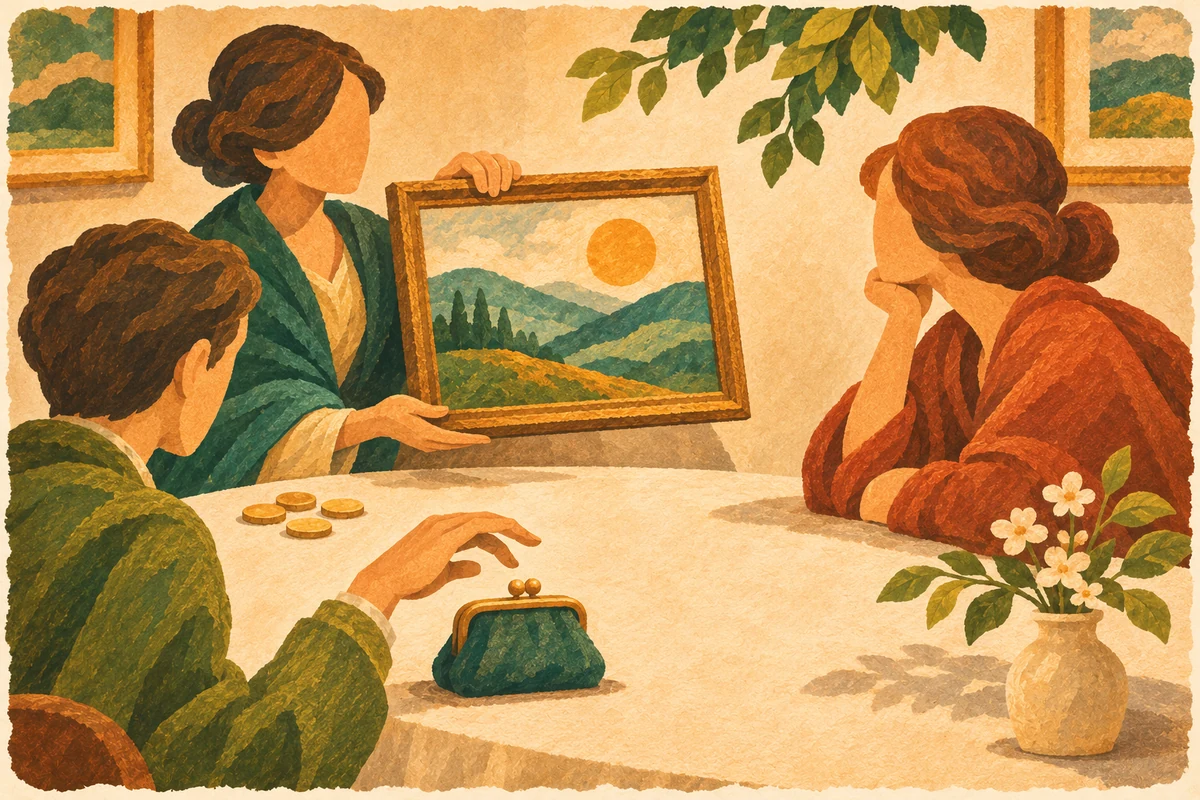
What half the value tells you
When you buy another player’s painting, you pay that player. If you pay 15 and later collect 30 from the bank, you have gained 15 overall. The seller has also gained 15 from the sale. The card came from their hand; they did not first pay the bank to put it up for auction.
That is the arithmetic behind half value. Your gain is the payout minus the price; the seller’s receipt is the price. The two amounts are equal when the price is half the payout. Above that point, the seller receives more than you net. Below it, you net more than the seller receives.
This warning is useful. A profitable purchase can still give an opponent a bigger gain. The existing BoardGame Archive strategy guide makes that point too. But the equal split compares the buyer with the seller inside one transaction. Deciding whether to buy requires another comparison: what happens if you decline?
The buyer waiting after you
Here is an invented three-player example using the fixed-price auction. A offers a painting for 17. B sits immediately to A’s left, with C next clockwise. B gets the first opportunity to buy at that price; if B passes, C gets the opportunity. Once either player buys, the auction ends. If both decline, A must buy the painting, paying the bank.
Assume everyone has at least 17, and this is a legal auction during the first round, before any artist’s fifth painting has been played. For the comparison, assume this painting’s artist eventually finishes first, so the painting pays 30. Also assume C will buy for 17 if B declines. Keep the later play and payout the same in both branches.
The table isolates the money from this purchase and the painting’s eventual sale to the bank. Other transactions are left out of both branches.
Scroll across the comparison if needed.
| B’s choice | A: seller | B: first buyer | C: next buyer |
|---|---|---|---|
| Buy for 17 | +17 | +13 | 0 |
| Pass; C buys for 17 | +17 | 0 | +13 |
Passing does not undo the seller’s income
If B buys, A gains four more than B from this transaction: 17 against 13. That looks unattractive when considered alone. Yet if B passes and C buys, A still gets 17 while B gets nothing. Against A, buying leaves B 13 better off than passing.
Against C, the difference is larger. Buying puts B 13 ahead of C on this transaction; passing leaves B 13 behind C. Buying improves that comparison by 26. Under the stated assumptions, B improves its position against both opponents by paying more than half the payout.
That does not prove B will win, or that 17 is a generally good price. It shows why refusing an unequal split can be costly. In this example, declining the purchase hands its profit to the next buyer without depriving the seller of anything.
C’s willingness is an assumption, not a rule. If C also passes, A must pay 17 to the bank and would net 13 after the assumed payout. That is a different branch: A no longer receives 17 from another player. You need to consider that possibility rather than carry the first table’s seller income into every outcome.
Before accepting the price
Start with the payout estimate. In the first round, paintings by the three highest-ranked artists pay 30, 20 and 10 respectively; other artists’ paintings pay nothing. Rankings depend on how many paintings of each artist were played, with ties broken by their order on the board. Playing an artist’s fifth painting ends the round immediately. That fifth painting counts for ranking but is not auctioned.
So 30 in our example is a conditional outcome, not a guaranteed price printed on the card. At a payout of 20, paying 17 leaves only 3. At a payout of 10, it loses 7. In later rounds, an artist’s earlier value tiles add to its payout only if it ranks in the top three again. Past success does not prevent a worthless round. The official CMON rulebook explains these payments and auction procedures.
Then follow the money and the alternative. Four questions keep the half-value shortcut in proportion:
- What payout am I estimating, and which remaining card plays could change it?
- Who receives my payment: another player or the bank?
- If I decline, who is likely to buy, at what price, and how does that change each player’s money?
- Does buying leave enough cash for later opportunities, and might this purchase change the later play I assumed?
When the auctioneer buys
The payment destination is a firm boundary on the half-value comparison. When the auctioneer buys their own painting, they pay the bank. At a price of 17 and payout of 30, they net 13, but no rival receives the 17. There is no buyer-seller profit split between two players to equalize. The purchase can still be poor because of risk, scarce cash or a better alternative; half the payout does not identify those costs.
Should you ever pay more than half? Yes, as the worked example shows. Half value tells you when the seller’s receipt exceeds your estimated net gain. To decide whether to buy, put the likely outcome of passing beside it. Sometimes the seller gets paid either way, and the real choice is which buyer keeps the remaining profit.