
The Royal Game of Ur is known from ancient boards with twenty squares, playing pieces and dice. Those objects raise questions that anyone trying to play must answer: where do pieces enter, how far do they move after a throw, and how does someone win?
Working out rules means comparing the equipment with surviving writing and deciding what each can establish. A later Babylonian text provides important clues, but it comes from a different period and describes different equipment. That gap is central to understanding the versions we can play today.
What a surviving board can show
One board excavated at Ur is held by the British Museum as BM 120834. The Cuneiform Digital Library Initiative, a scholarly catalogue of ancient objects and writing, records shell and wood among its materials and lists it as having no linguistic content. Its squares and decoration survive; written instructions do not.
Imagine trying to decide what a decorated square does. It could be a safe space, a place to earn something or simply a marker. Seeing the pattern is enough to ask those questions, but choosing between the answers takes more evidence. The board gives us an arrangement to explain.
The written clues come much later
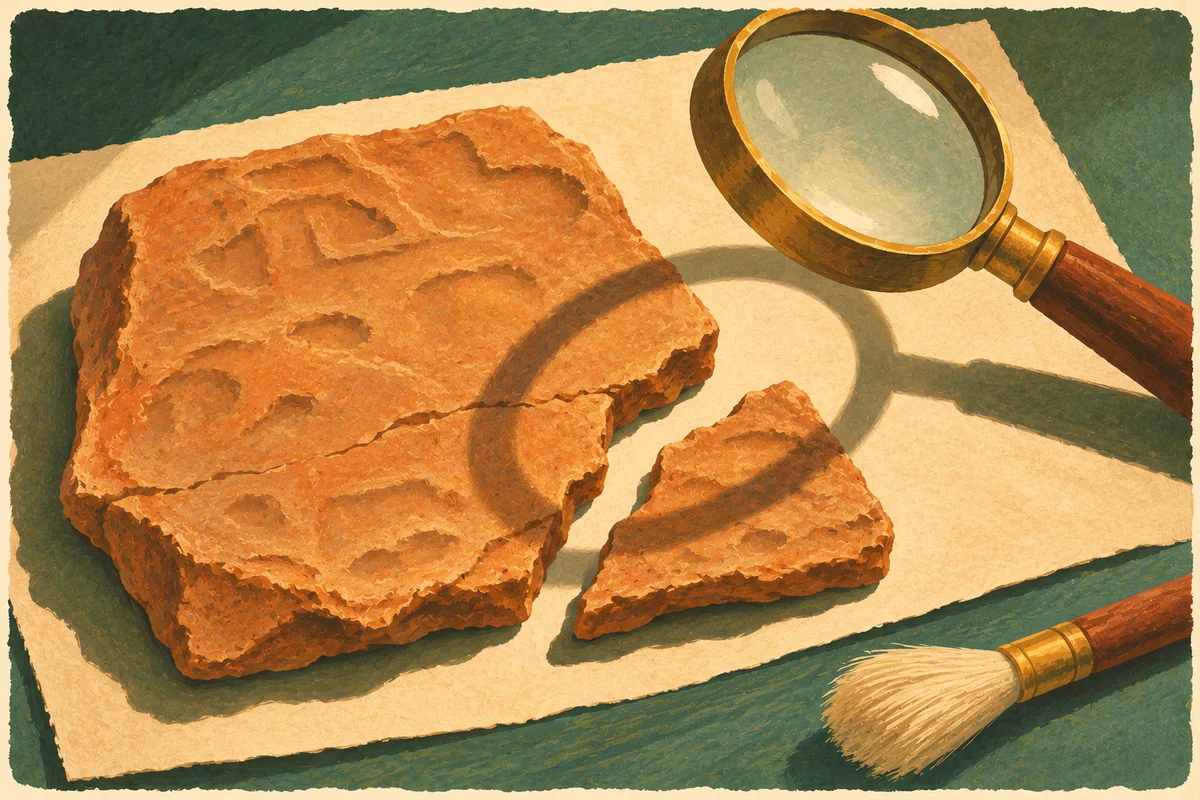
In his 2007 study, Irving Finkel examines a Babylonian clay tablet dated 177–176 BC. Its writing is cuneiform: signs pressed into clay. He connects it with a later form of the twenty-square game.
The differences matter. Finkel describes the third-millennium-BC boards with seven identical pieces for each player; the later text names five different pieces. It gives required throws and consequences involving marked squares. Those details help explain a game, while also warning us against assuming that play stayed unchanged across the centuries.
Knowing which dice to use is only part of the answer
The later text calls for two animal bones used as dice: a knucklebone from an ox and one from a sheep. Required results reach ten, but Finkel says the exact method of scoring their throws remains speculative. He considers more than one way it could work. His proposed playing route also includes a choice for which he says there is no direct evidence.
This is where reading about a game and sitting down to play make different demands. A study can leave alternative explanations open. Players need an agreed result when the dice land and a route their pieces can follow. A reconstruction supplies those decisions so that a game can proceed, while identifying which decisions remain uncertain.
Reading a playable version with the evidence in view
Finkel’s chapter appears in Ancient Board Games in Perspective, pages 16–32. Reading it alongside the board’s catalogue entry lets you follow the work from an object to a written clue to an interpretation.
If you try a modern set of rules, look for an explanation of which period and evidence it draws on. That helps you understand why two versions may differ and which details are proposed. You can enjoy playing without treating every move as something proved about the earliest boards. The surviving game is interesting partly because there is still room to investigate how people played it.