
In Bohnanza, you collect bean cards in fields in front of you. Each field holds one kind of bean. To earn money, you harvest a field: remove all its cards and check their printed scale to see how much the crop pays. A larger crop can earn more, and the player with the most money wins.
Your hand creates a problem. You must keep its cards in the order you received them, and the first card must be planted at the start of your turn. If both of your fields contain other kinds of beans, you have to harvest one to make room. Giving that first card to another player can help you avoid an early harvest.
A gift that changes your next turn
Consider an invented four-player game, where each player has two fields. Your fields contain blue beans and red beans. The first card in your hand is a garden bean, followed by a blue bean. It is another player’s turn, and they have reached the part of the turn when they can trade.
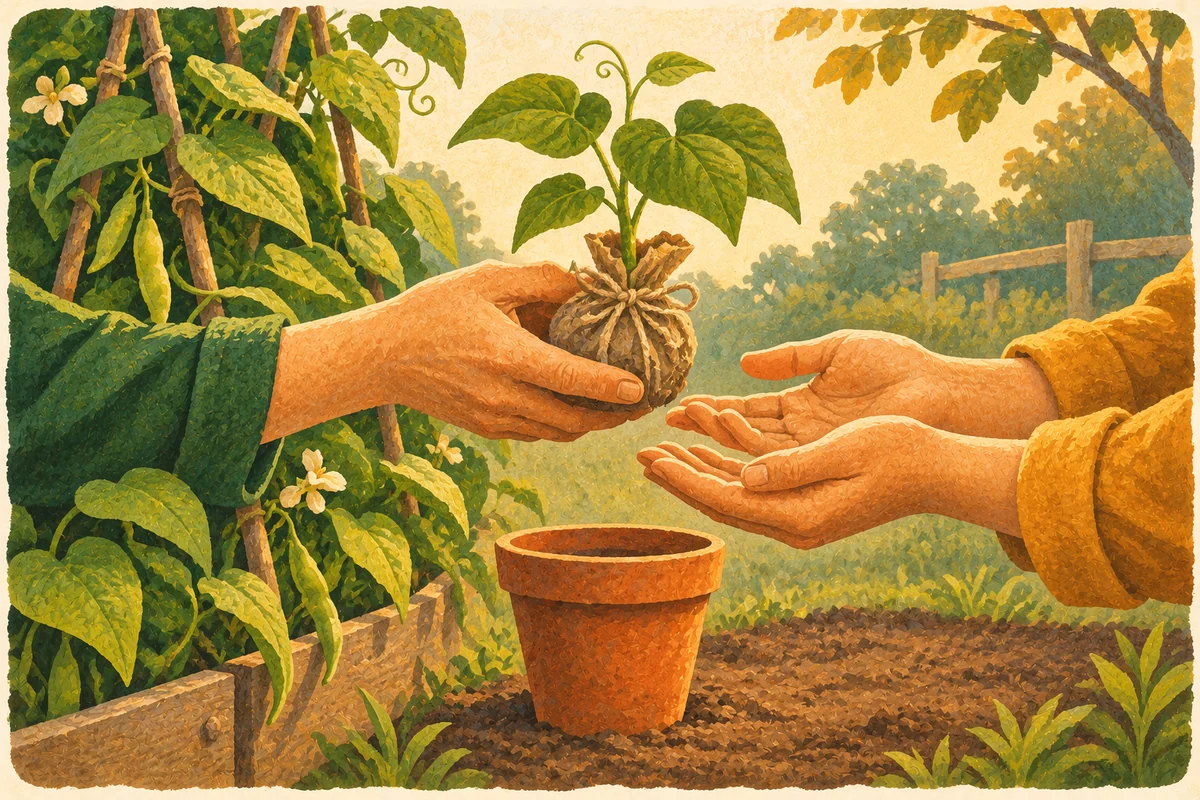
You offer that player your garden bean for nothing. If they accept, you remove it from your hand and leave the remaining cards in order. Your blue bean is now first. Provided you keep your blue field, that card can join it when your turn comes. You no longer have to empty a field just to plant the garden bean.
The gift has let you keep both crops growing. Whether that is worth doing depends on what those crops could earn with more beans, but it explains why giving away a card can be a useful offer.
What the recipient must do with the bean
The recipient cannot put your gift in their hand and save it for later. Cards received through trades and gifts are set beside the fields, then must be planted when trading ends. They cannot be traded to someone else.
If the recipient already has a garden-bean field, your gift can join it. If their fields hold other kinds, they will need to harvest one before planting it. They are allowed to refuse your gift, so look for someone who can use the bean without giving up a crop they value more.
There is another restriction to check before accepting. A field containing just one bean cannot normally be harvested while another field has more than one. If the recipient has one blue bean and several red beans, they cannot simply discard the lone blue bean to make room for your garden bean. They would have to harvest the red field instead.
Make the offer while it can still help
All trades and gifts must involve the player whose turn it is. During their trading step, anyone may offer cards from anywhere in their hand, but the other players cannot trade directly with one another. Wait until an offer is accepted before removing the cards; the order of the cards left behind must stay the same.
For the garden bean at the front of your hand, the useful opportunity is on someone else’s turn. By your own trading step, you will already have planted your first card. You can still offer a card from later in your hand to make a future turn easier.
Before offering a free bean, look at the other player’s fields. Can they add it to a crop they want to grow? In this example, that would let you keep your blue and red fields while they gain a garden bean. You both have a reason to agree, even though no card comes back to you.
Explore further
The game pages below include overviews, rulebook links and teaching videos.